![]() |
| Adrienne Lyle & Salvino |
Friday, June 11, 2021
U.S. Dressage Olympic Observation Event - Grand Prix Special
Wednesday, June 9, 2021
U.S. Dressage Olympic Observation Event - Grand Prix
There were no big surprises in the top four scores tonight,
so I suspect that group will form the US team of three and traveling reserve. But we will see how the Special goes on Friday! Overall, the class was nice to watch. A couple horses had resistant moments, but the riding was consistently quite subtle and friendly, even when things weren't perfect.
Adriene Lyle, Salvino – 82.413%
Salvino really powered forward in the extended trots. Lyle lost the quality of the trot slightly in the half-passes, however. The first passage started a little hurried and while Salvino is really active behind, he could push a bit more honestly forward in addition to springing up behind. The extended walk had excellent stretch and activity. The second piaffe crept forward but was active and expressive. The canter transition from passage could have been smoother. Like in passage, Salvino could have used his hindlegs to push more clearly forward in the twos, though Lyle rode them forward and straight. The pirouettes were sitting with very good bend and balance. Their final centerline was dead straight with lots of knee action. I found myself a little surprised by how high the score was, though the overall picture is one of power and harmony.
Adrienne Lyle & Salvino
Sabine Schut-Kery, Sanceo – 78.978%
- Sanceo has a lot of flash in his front legs, but the hind legs don’t quite keep up in the extended trots. Schut-Kery rode the most lateral reach Sanceo could offer in the trot half-passes. The passage was bouncy, but Sanceo could step a little more under himself in each stride. The piaffe had sit and spring. The extended walk was limited. The second passage was better and the second piaffe effortlessly excellent. The twos started strong but lost a touch of energy. The ones were straight and uphill, but small. The first pirouette got a little hurried, and the second was bigger but more controlled. The horse’s haunches looked slightly off to the left on the final centerline, but otherwise, the rhythm and energy of the passage and piaffe was superb. Interestingly, the high and low scores were 5% apart.
Steffen Peters, Suppenkasper – 77.696%
- Peters rode an excellent first halt. While the gelding could open up in his frame a hair more in the extended trot, the reach of the horse’s stride is really impressive. In the trot half-passes, Suppenkasper really swings, but Peters’ contact could have been a bit more subtle. The reinback steps were tiny and tight. Suppenkasper really reached under himself in passage, but could push more forward. The extended walk was not the most active, but showed very good overtrack. The horse cantered a step into passage. Supperkasper can really drop his croup in the piaffe, as few other horses in the class can. The transition into canter was not quite clean. The twos could have showed a more dynamic and uphill canter. The extended canter was big and relaxed. Peters really pushed his horse sideways in the zig-zag. The pirouettes had excellent sit and a clear canter rhythm. On the final centerline, it was apparent that this horse balances himself by getting quite wide in front, which limits the pair’s scores. There were also some small mistakes in transitions, but overall, Peters shows his ability to ride for every point.
Nick Wagman, Don John – 75.652%
- The horse got ever so slightly irregular in the early trot work, but Wagman fixed the issue by the end of the half-passes. The trot half-passes were lofty, but the horse could reach more sideways. The piaffe needed more sit. Don John’s hind leg stayed really active in passage and stayed under the horse well, though right before the canter, we got to see the potential for the movement to cover even more ground. The rhythm of the collected walk was good. In the zig-zag, the half pass right looked easier than the one to the left. There were 17 ones and the left changes never jumped fully through. The pirouettes were small. The final trot extension was not the most powerful but showed lots of freedom in the shoulder. The final piaffe was dead straight and perfectly regular. While there were minor issues, the overall picture was harmonious.
OliviaLagoy-Weltz, Rassings Lonoir – 75.131%
- The secure frame and quiet hind leg of this horse reminds me a little of Tinne Vilhemsen Silfven’s Don Auriello. The first halt was not in balance despite a very nice collected canter up to it. The extended trots were not the most powerful, but the horse showed good reach in front and behind. In the trot half-passes, the bend was good, but the haunches trailed just slightly. The transition from the second extended trot to passage was a little slow. While the passage and piaffe were not extravagant, Lagoy-Weltz managed the rhythm and transitions extremely well. The twos were nice and uphill, if not the most ground-covering. The change to the left was better than the change to the right in the ones. The first pirouette started a little big, but improved; the second was tiny, if a little quiet in the canter. After the canter, the passage showed extra expression, making the final centerline a real highlight.
Alice Tarjan, Candescent – 74.282%
- This mare has huge expression in the front end. Tarjan really showed it off from the beginning in the trot extensions and half-passes, though in the extensions, the mare could have stepped more under herself behind. The horse struggled to push and carry at the beginning of the first passage, but sprang well from piaffe back into passage. The extended walk could have shown more swing through the back. The mare anticipated the passage after the walk quite early. The piaffe was smaller than some of the other horses but had generally better rhythm and sit than those in her score range. The twos were bouncy and ground-covering. The extended canter was very uphill and ground-covering and not the least bit hurried. A real highlight. The ones were fluid and easy-looking. The tiny pirouettes could have had a slightly better canter rhythm. Tarjan really rode the last extended trot, but got more expression in front than the horse could keep up with behind. The pair showed a very classy final centerline, with spring and balance. I can see this combination going further in the future.
Charlottle Jorst, Nintendo – 73.631
- Jorst has a slightly funny seat with turned-out toes and horizontal hands that get busy at times, but she clearly has an effective rapport with this horse. The trot extensions are bright, but could have shown more freedom in the back. The first piaffe was small, but the transitions out were good. Jorst dropped the contract a little in extended walk, rather than asking the horse to stride into the bridle. The second passage rhythm was very secure. The two tempis were nicely uphill, though Jorst turned the horse’s head from side-to-side slightly in them. Nintendo got slightly above the bit following the extended canter, but his rider corrected quickly. Jorsts aids were impressively subtle in the ones. The second pirouette turned a little more around the middle of the horse. The final centerline was dead straight with absolutely no change in rhythm.
Ben Ebeling, Illuster van de Kampert – 72.565
- The picture in the trot work was very pleasant with correct bend in the half-passes, but the trot itself could have used a bit more spark and power. The piaffe and passage was smooth, but the hind legs could have carried more. While the second passage showed a bit more expression, the piaffe traveled a bit too much forward. The twos were uphill and ground-covering, though the horse could jump ever so slightly more honestly into the bridle in them. The balance was not completely secure in the zig-zag. The ones started a little croup high, but improved significantly towards the end. The transition from canter to trot was smooth, but a little flat. The final centerline was straight and easy-looking. Overall, the test was correct with quiet, subtle riding from Ebeling, but a little conservative.
Adrienne Lyle, Harmony’s Duval – 72.456%
- I personally really like this horse’s supple way of moving, but he does struggle in subtle ways with the high degree of collection required in Grand Prix. Because of this, he does get a little tight in the neck and heavy in the bridle. For instance, the neck drops as opposed to lengthens in the flashy trot extensions. Lyle got Duval to really swing sideways in the half-passes. There was some irregularity in the first passage, with more engagement in the left hind. The fluid twos were beautifully managed by Lyle. She lost some of the expression of Duval’s uphill canter in the zig-zag. Lyle rode the pirouettes in very good balance, including the steps off and on the centerline.
Jennifer Williams, Millione – 70.848%
- Williams looked thrilled to be there, with a broad smile on her face from the moment she entered the stadium. Millione’s trot is a little pony-ish behind and he got a bit heavy and braced in the contact at times. The extended trots were a little quick in the rhythm. The piaffes had good rhythm and lightness in front. The transition from collected walk to passage could have been more prompt, and that stickiness showed up as a moment of resistance to the bridle in the second piaffe. Millione showed lots of shoulder freedom in the two tempis, but they should have still been a bit more elevated in front. The ones were rather short. The second pirouette got big but had very good canter rhythm.
Susan Dutta, Figeac DC – 70.000%
- Dutta kept Figeac in a nice, consistent frame, though the horse brought his tongue up a little. While the passage had some irregular steps, when it wasn’t, the engagement was good. The piaffe could have been a little quicker in the rhythm and more in place. In the two tempi changes, the horse sprang off the ground, but could have jumped more forward. Dutta had good control of the balance in the zig-zag and the pirouettes, though the pirouettes could have been more uphill.
Susan Dutta, Don Design DC – 68.456%
- Don Design entered looking a little impressed with the arena and showed subtle tension throughout the test. The first extended trot was a bit hurried. The trot-half pass right lacked bend, but the one to the left was better. The rein-back was slightly rushed but showed clear diagonal pairs. The horse did not sit at all in piaffe, but it was bouncy. The collected canter at times got a little flat. Dutta had an error in the twos. The canter pirouettes got rather big and slow. Dutta got a lot of loft and expression in the final passage to leave a good final impression. This horse showed a lot of power behind, but could use it better in carrying himself more uphill as he develops further.
Nick Wagman, Ferano – 66.674%
- Ferano is a really light-footed horse but does not have the most scope in his gaits. Tonight, he looked slightly behind the leg, making it hard for Wagman to get the highest degree of self-carriage out of the horse. The trot half-passes a were little passage-y. The horse unfortunately halted in the first piaffe. Ferano could have stepped a tad more under himself in passage, but it was airy. The horse tilted his head slightly in the extended walk. The twos and ones were lofty and uphill, but there was an error in each. The final passage to X was looking good, but the horse halted again in the piaffe.
Jessica Howington, Cavalia – 63.413%
- The mare looked a little sluggish this evening, making it hard for Howington to push her up in the bridle throughout the test. The horse hung subtly on the bridle from start to finish. The trot half-passes swung nicely sideways. Unfortunately, the mare put up a big resistance to the first piaffe, so that no piaffe was shown. Cavalia’s hind legs could have come more under her in the second piaffe and passage, but Howington looked like she was riding them a little cautiously. The twos looked easy but needed a bolder canter. There was a small mistake in the ones. The pirouettes were nicely uphill and controlled, but the horse got quite deep in the frame. Howington looked understandably disappointed.
Thursday, March 30, 2017
FEI World Cup Final 2017 Omaha - Grand Prix
Laura Graves and Verdades (79.800%) struck off with power from the first step out of the halt. The trot half-passes show incredible flexibility in crossing and Graves gets them really powering sideways. The passage had lots of air-time but was a little too forward. In piaffe, Verdades keeps a rhythm, but never really sits. The extended walk was supple, but Verdades could have stretched a little more into the bit. The second passage was more controlled, and in both the piaffe and passage, Verdades really picked up his his feet. The canter work was consistently very strong. Verdades has such a clear rhythm in it. The two tempis were superb, in a big, supple, effortless-looking canter. Like in the trot half-passes, Graves really gets her horse to step sideways. The first canter pirouette was super: tiny, uphill, and controlled. There was a small rhythm error in the second. The final piaffe was the most like a true piaffe, with the hindlegs coming under a little better. Unfortunately, the double coefficients for the piaffe limit the score of an otherwise spectacular test.
Though the rather lumbering Nip Tuck doesn't make my heart sing, there is no question Carl Hester shows amazing feel riding him (76.671%). The horse looked nicely compact and uphill coming down the centerline, but got slightly strut out in the extended trot. Hester kept the half-passes in a very slow collected trot, sacrificing a bit of expression to keep him together. The piaffes looked effortlessly rhythmical and sitting. The extended walk was quiet and the collected cautious. The passage after the walk looked soft and effortless. The tempi changes jumped expressively off the ground. Hester controlled the canter pirouettes well, but can't quite get Nip Tuck to really lift off his forehand. Though the in passage Nip Tuck could step more not just up but under behind, Hester rode the final line with impeccable accuracy.
Edward Gal had a solid ride on Voice (74.486%). Gal rode stunning trot half-passes, with the horse wrapped around his inside leg, crossing beautifully. Voice looked slightly sucked back in the first passage and piaffe, with the activity escaping out behind a little; the second was improved. The two tempis started a little flat, but gained lift and uphill tendency across the diagonal. The canter pirouettes were really sitting. There wasn't really a final halt. Overall, Voice gave the usual the impression he could reach more forward into the bridle.
Judy Reynolds had Vancouver K (74.443%) a little hurried at the start of her ride, but pulled together very high-quality half-passes where the horse's uphill movement allowed for lots of expression in front. In the passage, Vancouver K really elevated in front, and he sits well in the piaffe. Unfortunately, the first piaffe was a tad tense and quick in the rhythm. The tempi changes were ridden really forward and were dead straight. The canter pirouettes were controlled and sitting, but got a little big. Reynolds overall rode a very precise test with expression and a consistent frame.
Madeleine Witte-Vrees and Cennin (73.900%) showed really impressive animation, especially in passage, but it sometimes seems a little under-supported by the activity behind. In piaffe the horse closes well at the base. The transitions in and out of the second piaffe were much clearer than those of the first. Cennin reaches way under himself in the tempi changes, but swings his haunches a little. With-Vrees also had an error in the ones. Cennin got a little open in the frame and downhill in the pirouettes, not quite able to maintain the collection Witte-Vrees established in the preparation. On the final centerline, Witte-Vrees looked like she could have used to have a little more horse left.
Kasey Perry-Glass had a few minor early issues with Dublet (73.829%). Their extended trot started a bit irregular and the half-passes could have moved more easily sideways. Dublet crepes forward a tiny bit in piaffe, but really sits and then springs forward cleanly into and engaged passage. The extended walk was fluid, with Dublet swinging well through his back. The two tempis were really bold and ground-covering. the canter pirouettes were beautifully controlled and balanced. The horse's tongue showed quite a bit on the right side in the final extended trot (and perhaps it did elsewhere in the test when I couldn't see it), though it might have been hard for the judges to see through the foam on Dublet's mouth. Throughout, the horse's confirmation means its hard for Perry-Glass to keep him in front of the vertical, despite not holding a strong contact.
Steffen Peters' Rosamunde has a similar light frame and compact build to his Olympic team horse Legolas, but with more power in the more forward work (72.257%). The extended trots are open and ground-covering, but could have a little more suspension. The runback showed clear steps but seemed a little green. Rosamund sat too much in the first piaffe, with her hindlegs almost stepping on the heels of the front, and the mare got stuck. The walk work was tense and Peters couldn't get the mare to really sit. The second piaffe was still a bit unsteady, but so expressive. The twos were uphill with lots of shoulder freedom, but a tiny bit crooked. The mare's flexibility was a bit of an issue in the canter zig-zag: while the half-passes covered a lot of ground sideways, the mare swung her haunches a bit in the changes. The first canter pirouette was a true highlight, but Rosamund unfortunately got a bit stuck in the second. Overall, Peters' test showed a lot of softness that really brought out the mare's natural talent, but the work still seems a little green and sometimes a little difficult to manage.
Inessa Merkulova was back again for the finals on her show-stopping Mister X, though he looked a bit tired (71.929%). The horse showed lots of shoulder freedom in the extended trots, but Merkulova could have allowed him to open up a bit more in the frame. The trot half-passes needed to move more fluidly sideways. Both the first and second passage and piaffe started uncharacteristically hesitant (while still well above the average in the class), but the first passage finished with impressive sit and knee-action. Though Mister X doesn't have the greatest overtrack in the extended walk, he was moving well thgouh his back. The flying changes could have been straighter. The horse got a little bit deep in the bridle in the canter zig-zag. Several of the one tempis were a little short behind, and they could have been freer in front. Mister X sits incredibly in the canter pirouettes, but Merkulova gave them a bit the appearance of the haunches getting ahead. The final piaffe was remarkable, but there were a few rhythm errors leading up to the halt.
Kristy Oatley and Du Soleil (71.829%) started with an extravagant floating extended trot. In the passage, Du Soleil pushed himself way off the ground, but got a little irregular and out behind. The first piaffe was diligent and rhythmical, but could put a bit more weight on the handles. The second piaffe stayed up better in front. In the two tempi changes, the horse gets a bit tight, jumping off the ground, but not reaching enough forward through his body. The one tempis were clean, but started with a strong snort of tension. the canter pirouettes were small, but lost a bit of their forward feeling, as the horse almost stepped onto himself behind. The transition to trot from canter was sticky. The final piaffe was very strong.
Marcela Krinke Susmelj showed up again at the World Cup Finals on her solid Molberg (71.529%). Krinke Susmelj looked like she was struggling a little with her horse's suppleness and was playing some with the left reins. Krinke Susmelj did a nice job keeping her horse's haunches coming under, especially since he has a bit of a tendency to push up behind. In piaffe, Molberg is not the most expressive, but Krinke Susmelj does a nice job shortening his frame. The canter zig-zag was very accurately ridden. The canter pirouettes lost jump as the horse became a little braced above the bit. The final centerline was clean with a lovely regular piaffe and passage.
Mai Tofte Olesen's Rustique has nice suspension in his gaits, but sometimes gives the impression that his hindlegs get a bit disconnected (69.786%). The bend could have been a bit more honest in the trot half-passes. Tofte Olesen did a nice job keeping the suspension and rhythm in the piaffe and passage, though the horse drops his back a little in it. The tempi changes weren't the straightest as the horse got a bit braced behind. Tofte Olesen had a counting error in the canter zig-zag. The canter pirouettes were small, but not the most uphill. The final steps of passage were soft and easy.
Joao Victor Marcari Oliva had a very polished ride on Xama Dos Pinheads (68.214%). The extended and collected trot was very supple and ground-covering, but the stallion struggled a little with the bend and crossing in the half-passes. The passage could have a bit more suspension and the piaffe a bit more activity. The transitions could also be cleaner. The second piaffe was more active and sitting. One of the two tempis was a bit short behind. The canter zig-zag did not travel much sideways. While the horse sits well in the canter pirouettes it comes at the expense of some jump in the canter. And what a nice temperament the stallion has, walking out of the arena on a dropped rein even with the crowds cheering loudly.
Maria Florencia Manfredi rode Bandurria Kacero for Argentina (66.500%). Manfredi rode in a very forward and positive way but lost some points on accuracy, anticipating movements and riding them ahead of their place. The horse is a powerhouse from behind with a lot of elasticity, but gets a bit irregular in the trot and passage. In piaffe the horse is springy, but bobs his head a little with the effort. The horse's walk was quite limited. The canter zig-zag was a little inaccurate, with the horse's haunches getting left behind and then catching up. The canter pirouettes could have show a clearer canter rhythm.
Hanna Karasiova rode her very attractive but quite overwhelmed Arlekino for Belarus (58.886%). In the extended trot, the bay really stepped under behind, but Karasiova couldn't maintain that engagement into the passage and piaffe. The transition from walk to passage was muddled and the horse took a step backward in the subsequent piaffe, and it seemed like the horse unfortunately built up some tension, as he started the canter work with some nervous snorting. Karasiova was conservative in the extended canter to try and keep her horse's energy down, but unfortunately had an early change that wasn't clean. The one tempis were expressive, but could have covered a bit more ground. Arlekino showed how well he can sit in the canter pirouettes. The final passage showed much better engagement, but unfortunately in the piaffe at X, the horse got tense and crooked.
Wendy Williamson of New Zealand rode Dejavu. The black gelding has a lot of suspension and power from behind which Williamson worked to contain to her advantage. The transition from passage into the first piaffe was unclear, but the piaffe and passage themselves were springy. The extended walk needed more relaxation. The tension appeared to creep into the canter work, as the canter got a bit close behind, particularly in the tempis. One of the changes in the canter zig-zag was in two phases. Williamson had a problem in the first canter pirouette. The final centerline showed a nicely uphill passage and piaffe with Dejavu really picking up his hindlegs, and resisted the urge to turn and run out of the final halt. She was sadly eliminated after her ride.
Monday, August 15, 2016
Rio 2016 Olympic Individual Dressage - Grand Prix Freestyle
The Olympic final was every bit as exciting as it promised to be. Even though the winners of gold and silver were not much of a surpise, the audience was treated to some incredible dressage from the top four, and especially from The Professor's last great performance.
Isabell Werth entered with her usual total focus and was on beat from the first step of passage. The passage was regular, and engaged and Weihegold sat in the piaffes while mintaining almost the same activity behind as in the passage. One transition out of piaffe had a little double beat. The half-passes in trot were active and powerful and absolutely correct bend. Werth does not give away any marks and really rode even the extended walk, which was marching with lots of overtrack. Weihegold struggled a little with the transition from extended canter to a double pirouette left, but Werth finessed it so that the pirouette came off clean and active and sitting. The tempis don't have the most ground cover, but the canter is maintained with activity and fluid strides throughout the changes. The extended trot is this mare's weakness as she tends to want to hurry downhill, but Werth kept them from rushing, even though she cannot really get the mare to step under behind. The final piaffe was executed in a full pirouette, which other than a minor stutter-step sprang way off the ground with such a clear beat. Isabell Werth won the silver with her clever riding to become the most medal winning equestrian (89.071%).
Kristina Bröring Sprehe had a bit of an unclear start with an abrupt halt and a half-pass between passage and collected trot, but once she transitioned to her first trot half-pass the work was easy and beautiful. The half-pass left was a little passagey in the rhythm. The piaffes, ridden across the centerline at G were super sitting, but a little awkward in the transition out to passage. Bröring Sprehe's extended walk to piaffe quarter-pirouette to collected walk is one of the most beautiful movements in any freestyle: the transitions are so easy and the work of such quality. A big walk with active overstep. A sitting piaffe. The canter pirouettes were not the most well-placed around a point, but were in an excellent sitting canter. The canter in the ones tempis had a lovely beat, but the horse could step a tiny bit more into the bridle. Other than minor imperfections in the transitions out of piaffe, the curved lines of passage and piaffe to the final halt were easy and beautiful (87.142%).
Laura Graves started off with and easy looking passage half-pass to one of Verdades trot half-passes with his incredible reach across the arena. Her timing with the music was excellent and the passage big without tension or snatching throughout the test (except an early little stumble). The piaffe, as usual, was in rhythm and in place, if still not truly sitting. The collected walk was quite cautious, but Graves slowly established enough relaxation in her horse to get decent stretch for the extended walk. Verdades again showed his incredible lateral flexibility in the canter half-passes. The extended canter was a little tight in the body, but Graves brought Verdades back into a beautifully balanced and through canter in a pirouette. Graves twice rode two tempis on a circle to ones on the short diagonal. the twos were supple and uphill and the ones expressive, with consistency of the canter maintained all the way through. The final piaffe was a little haunches-right, but in the final passage, Verdades showed how he could really lift his body and articulate his limbs with supple activity (85.196%).
Severo Jesus Jurado Lopez has really gotten the swing of this horse for the Olympics, as overall, the Lorenzo's movement is much more managed. Jurado Lopez doesn't have the most independent seat, so the contact is a little inconsistent at times. But he really gets expression out of Lorenzo. The extended trots were powerful from behind and uphill, but a touch hurried. The passage had lots of suspension, but a little more today than in the Special, the activity of the hindleg moved more up than under the horse. The collected walk was a little backed off the contact, but the extended walk had nice stretch. The quiet musical transition Jurado Lopez chose from walk to canter really matched the easy transition, and the canter pirouette immediately after was really high quality. The horse gets a bit wide behind and doesn't really open in the frame for the extended canter. The tempis were not the smoothest, but were uphill and had lots of jump. The crowd was clearly crazy about this bright-eyed horse, as they cheered for Jurado Lopez as he passaged one-handed to his final salute (83.625%).
Dorothee Schneider had a little trouble finding her rhythm in the first passage half-pass, but it was a very minor thing, as she changed directions into a fluid trot half-pass where the horse bends so well in the body and really crosses. The piaffes, which were nicely closed at the base, could sometimes be a bit more on the hindleg, though the one in the walk work was really sitting. Schneider tried a tricky half-pass to canter pirouette to half-pass, and though the one to the left was gorgeous, Schneider lost the canter in the one to the right. The tempi changes were really off the hindleg and expressive in front. A later double pirouette to the left got a bit big and hurried, showing a little where Showtime is a bit inexperienced. The extended trot to piaffe showed the horse's ability to go with ease from a powerful pushing hindleg to the carrying one. Overall, Schneider couldn't keep the horse quite as steady as in the special, getting that little bit over tempo, but it still showed Schneider's talent for letting a horse really move under her (82.986%).
Carl Hester chose big music for his big gelding Nip Tuck. The piaffe full pirouette after the halt was beautifully sitting, with Hester getting particularly good activity from Nip Tuck behind. Hester then struck off into canter, where he had the long-in-the-back gelding looking round and compressed. The tempi changes were uphill and scopey in every stride and so lovely in the frame. Nip Tuck lengthens out a bit in the canter pirouettes where he struggles to really sit, but Hester keeps them super small and balanced as they turn. The collected walk was a bit short behind, but the extended walk finished with nice stretch. The trot half-passes were a little slow in the rhythm, though if Hester has asked for more, Nip Tuck's haunches would likely have gone flying out behind him. The extended trots were a rather limited. But the passage to finish was uphill and active behind. Hester's ability to compress this horse without strain or pressure is such a testament to his riding (82.553%).
Tinne Vilhemsen Silfvén had Don Auriello looking springy in the passage she entered on, and kept that activity well as she continued down the centerline. The flashy extended trot, marked with a transition to the fun Good Vibrations, needed a little more support from behind. Vilhemsen Silfvén rode a bunch of transitions from passage to collected and extended trot, which showed off how obedient and on her aids Don Auriello is. The extended walk showed nice settled overtrack. The first pirouette was not their more uphill, but still tiny. Vilhemsen Silfvén rode twos on a half circle, which could have been a big more forward, but were elevated and front and stayed even even on the curved line. The extended canter was big and determined without getting hurried. Vilhemsen Silfvén rode a one handed pirouette after a line of lovely twos where she looked like she almost lost her reins. And though the pirouette was small and sitting, I think the little disturbance in the contact resulted in a little bobble in the extended trot she rode next. They definitely had the good vibrations (terrible pun, I know!) going with the passage into the final halt, and had some of the most fun music of the day (81.553%).
Hans Peter Minderhoud chose some stirring music to start Johnson off in passage, and it was a nice choice to make a more settled impression. The passage pace was slowed down a little compared to the Grand Prix and the Special, giving Johnson a little more time to take even steps, and when he does he really reaches up in front. And for the most part today, the hindleg came well underneath him as well. The piaffes were a bit of a contrast with the passage, since they were rather small and not under behind, but still regular. The trot haf-passes were beautifully scopey, but the extended walk was definitely not, showing that Minderhoud was still wrestling with the horse's tension. The canter pirouettes were big and a little slow in the canter, but Minderhoud kept the strides around measured. They finished with a piaffe pirouette to an extended trot, but I would have thought an even better last impression would have been passage (80.571%).
Beatriz Ferrer Salat's elegant upright seat makes her look so light on a horse, especially the big, powerful Delgado. The difficulty with this horse is that he struggles to open up in his back, but this makes it especially impressive that Ferrer Salat keeps the frame from ever really getting tight. The passage was on beat step after step, with Delgado propelling himself up and forward with ease. The extended walk was relatively quick and underwhelming, and after, Ferrer Salat had a little trouble with the rhythm in an extended trot. The huge-striding twos and ones were quite noticeably crooked. Though the canter in the half-passes is active, Delgado gets a bit rigid in his body in them. The canter pirouettes today did not look the most secure in their balance, but Ferrer Salat keeps her horse's croup dropped and carrying. The finishing piaffe, where Delgado lowers his croup but stays active, and passage, where Delgado has effortless suspension, was just super (80.161%).
Diederick van Silfhout rides like is is always trying not to disturb the eager Arlando: it's a very soft seat even though the horse does not move much in his back. The horse looked strong as ever in the trot work, with his incredible shoulder freedom in the half-passes, passage, and extended trots. In extended trots and passage, the horse's active engaged hindleg could carry him a bit more uphill. The extended canter out of the walk was a little hurried, but van Silfhout brought the energy back for an active canter pirouette where Arlando really closed up at the base. And the contact in the pirouettes is feather light, with van Silfhout keeping the horse collected clearly from his seat alone. Van Silfhout had a couple errors behind in the first line slightly tight ones, though he repeated them successfully. The final piaffe and passage just shined (79.535%).
Steffen Peters has had Legolas at his best for these games: he's not the scopiest or the most elastic in anything but piaffe and passage, but he shined in those movements and everything else was supported with Peters' soft seat. After a bit of a sluggish start out of the halt, Legolas looked fresh and uphill in their first lines of piaffe and passage. Personally I'm not sure about the rap vocals Peters added to his music, mostly because I found them a bit corny, but I appreciate that he was having a little fun with them! Peters then struck off into canter to get some of the stickier movements out of the way. The twos came off clean. Both of the first pirouettes were quite big, though the canter in the second was better than the first. The one tempis were among the best Legolas has done: more uphill and scopey than usual (though still small compared to toher horses). Peters kept his characteristic canter piroutte to piaffe to walk transition in the freestyle, and it was super clean and obedient, though not showing the most expressive piaffe Legolas can do. Though Legolas is not the most elastic in the trot half-passes, Peters really gets him reaching sideways, and the second was more open in the body than the first. Peters rode three piaffe pirouettes, and though there were a couple tiny errors in the beat, overall, they were springy and effortless (79.393%).
Catherine Dufour started with a canter pirouette about five strides out of her halt that went immediately into super tempis, back to a canter pirouette, and back to tempis. The canter pirouettes were super sitting and active. Dufour was clearly showing where she deserves her marks: she can really ride, nailing one difficult movement after another in quick succession without stressing her horse. Dufour seemed to be riding for more expression in passage, mostly successfully, but at times that meant Cassidy got a little out behind, though he really sprang off the ground. The trot half-passes showed a powerful, expressive, regular trot. In extended walk, Cassidy could have moved more through his back. They then returned to the canter where the pair showed a perfectly balanced zig-zag before returning to piaffe and passage to finish the test.
Anna Kasprzak's freestyle cleverly starts out with the Donnperignon's lovely canter work: a pirouette, a line of ones, another pirouettes. In the pirouettes, the canter cleanly jumped uphill off the ground, but they got a bit big. The one tempis were superbly fluid and expressive. The first piaffe, ridden at A, was rather sticky, but Kasprzak had Donnperignon in a more open frame than she usually gets in it. The extended trots had plenty of power, and though Donnperignon doesn't naturally have the most shoulder-freedom, his good balance in the extended trots really allowed him to reach forward. In the trot half-pass left, Donnperignon's haunches lagged a bit. The twos ridden in a second canter tour later in the test were ridden on a beautiful curved line with each change jumping expressively through. Their finish with piaffe pirouettes brought the best piaffe out of the horse (76.982%).
Alison Brock could not have looked happier to make it to the freestyle at the Olympics: before she out her focused face on for the test, she rode a piaffe just beaming. Brock started out with a instrumental version of Sweet Dreams for the trot work. The first passage could have moved straighter off the hindleg and Rosevelt got a little high in front in the first piaffe. Overall, though, the piaffe and passage was pleasantly bouncy and always with the horse's nose nicely in front of the vertical. The slow sad music Brock chose for the canter didn't do the best supporting her muscular stallion. The canter pirouettes were a little rushed, but small. Brock struggled to get a flying change after her canter half-passes. The twos were really pretty and uphill, though could have shown a bit more engagement from behind. The final centerline showed their prettiest piaffe and passage, with Rosevelt supporting his expressive front with a more active hindleg (76.160%).
Patrik Kittel started Deja off with a big extended trot and her sparkling passage, where she has lots of knee action and an active hindleg (that could come a little more under the mare's body at times). He chose a pretty easy first half-pass line to the centerline and back, as the mare gets a bit irregular in the movement, even though she really reaches across the arena. In canter, the first of the two tempis was short behind, and though they were big and uphill; Kittel's effort to get them maybe interrupted Deja's rhythm a bit. Deja gets a bit wide behind in the pirouettes, but Kittel did a nice job keeping them in a clear canter. The ones, which were looking gorgeous, unfortunately had a couple errors. Overall, despite the pair's minor errors, they were really looking like a team. Deja now looks comfortable and certain at Grand Prix and shows her delicate power throughout the test (76.018%).
Fiona Bigwood's Orthilia looked bubbly and lively today, supported by some fun music with a beat. But she was still not completely in front of the leg, with the incredibly light-off-the-ground passage still leaning a bit forward, a break to canter before the first trot half-pass, and a little pulling down in the extended trots. In the second half-pass, however, Orthilia simply floated across the arena. In the first canter pirouette, Bigwood did a really clever job keeping her super talented mare in a canter that was controlled, but with a clear beat and super sitting. Their twos on a curved line had a couple errors behind. The one tempis looked easy and ground-covering. The canter work seemed to really motivate the mare because their final piaffe near A had so much lift. Unfortunately, the mare broke to canter in the extended trot to their final halt (76.018%).
Judy Reynolds' Vancouver K reminded me for a moment of Digby as he stepped out of the halt into a smallish trot on a ten-meter curve back to the rail. In extended trot, the horse doesn't really get elastic, and though he opens up his trot, its rather quick. Reynolds rode great active, uphill canter pirouettes, though sometimes couldn't quite nail the balance coming out of them. The extended walk was active, with the horse reaching for the bit, but he could have been a bit more over the back. After the walk, Reynolds had a piaffe where her horse seemed to want to climb to the sky, but though the tension crept in, she did a wonderful job settling her horse and stopping a major moment of resistance. In a later pirouette, Vancouver K changed behind. The final passage was a tiny bit short in the neck, but the horse stepped uphill in each stride. The piaffes looked a little trickier today. Vancouver K got a little bit hurried and tense, though he would really sit in them (75.696%).
Friday, August 12, 2016
Rio 2016 Olympic Team Dressage - Grand Prix Special
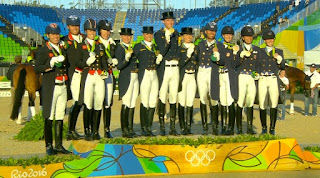
| The medalists! |
Isabell Werth has the most incredible focus and determination and rides for every step on every horse without pressure. Weihegold is not the most supple in the topline, but Werth gives her time to move, especially in the extended trots and half-passes. The half-pass right today was the best the mare has done. The passage pings off the ground in each step with ease and was very regular today. The extended walk did not have the most overtrack, but Werth has Weihegold really striding out into the bridle. The transition from walk to piaffe was excellent, and the mare really sat in the piaffe. Unfortunately, she built up some tension before the second piaffe and pulled down in the bridle in it. The canter half-passes were not the most supple, but were super uphill. The twos were ground-covering, the ones a tiny bit short. The canter overall today moved more forward and less up-and-down. The canter pirouettes were not the most up in the shoulder, but were still well-carried on the hind end in a controlled rhythm. The final passage had super engagement behind and the mare was beautifully up in the bridle.
Other than the one mistake, Charlotte Dujardin's test on Valegro was so easy to praise. The trot-extension balanced reaching strides with a lovely pushing hindleg. Dujardin has the same unfortunate communication error as Steffen Peters with a canter at the beginning of the first trot half-pass, which was enough to put them in second behind a fault free Werth. But she nailed the second half-pass. The passage steps were so softly elevated. Dujardin rode Valegro beautifully into a marching extended walk, even though it doesn't have the most overtrack. The first piaffe crept forward, but was so sitting and beautifully active. The second was also sitting, though not quite as quick as it has been. The canter half-passes were amazing, moving easily sideways with a canter that was so over the back. The tempis are off the hindleg in every stride. Valegro opens up his back for the extended canter, and shortened again with ease. Both pirouettes were small and uphill and so well controlled. The final centerline was super with the hindlegs supporting beautiful elevation in the passage and Dujardin half-halting seamlessly into a classical piaffe.
Dorothee Schneider's quiet forward ride did a beautiful job showing off Showtime. In extended trot, Showtime stepped way under himself and pushed really postively through the whole way with his hindleg. Though Schneider gave him plenty of rein, he didn't really open his neck in the extensions. The passage came way off the ground and the trot half-passes powered across the arena with ease. The extended walk showed huge overtrack, but had little stretch and was slow to develop. The piaffe out of the walk was really sitting, but the transition out was not quite clean. The tempis got slightly hurried as Schneider pushed them forward to cover ground. The first canter pirouette was tiny and sitting, though it wasn't really bent and the last step was close behind. The second pirouette was rushed. In the lovely expressive final line, Showtime could have stepped a bit more under himself.
Laura Graves started on a really dynamic extended trot, setting the tone for the test. And though Verdades was still a little short in the neck in it, he has developed a lot of suspension. The passage was electric without be frantic, with Graves appearing just to direct Verdades while he motivated himself in the work. She has such a beautiful seat that just allows him to move under her to his full potential. The extended walk needed more stretch and energy. The transition to piaffe wasn't clean and the first piaffe was a little out behind. The second was a bit better, though Verdades could still rotate his croup down more to close at the base. Verdades lateral flexibility in the canter half-passes was amazing. The two tempis were uphill and smooth with super shoulder freedom, the ones even better. The first canter pirouette was amazingly tiny and sitting, but Verdades lost his balance a little at the end of the second one. Their final centerline was spot-on until a little stutter step before the final halt. Graves has a bronze medal within her reach if she rides like that again for the Kur.
Kristina Bröring-Sprehe has developed such a lovely light open frame in Desperados' work that makes the difficult movements seem so easy. For me, the thing that always interrupts the picture is minor inaccuracies like the rhythm bobble before the first extended trot and the haunches that swing around like a boat in passage instead of truly following the front leg. The passage is so free and springy throughout, even though occasionally an irregularity sneaks in. The extended walk was super. The transition from collected walk to piaffe was messy and Desperados never found a clear diagonal beat in it. The second piaffe was fantastic, though. The canter half-passes were expressive. The tempis jump way off the ground and are uphill, but are not as fluid as some of the other top horses. The placement of neither canter pirouette was perfect, but Desperados sat incredibly while maintaining the canter. On the final centerline, Desperados was stepping more under himself with the left hind than the right, but still lifted himself way off the ground.
Carl Hester & Nip Tuck
Hester cleverly rides Nip Tuck in quite a slow rhythm to give his slightly out hindleg a change to keep up. The trot extensions have reach, but Nip Tuck can't quite get his hindleg under himself as well as he should. The trot half-passes were stunning, with the gelding becoming really elevated in front and reaching over to step across the arena. The passage is elevated, even if some steps are a little long in the frame. The transition to piaffe was seamless, with the horse just sitting down into the rhythm. The transition out was a little weak, however. And where Bröring-Sprehe drifts through corners, Hester quietly manages every step, keeping the hindlegs under and the energy pushing into the bridle. The ones were so smooth and uphill. The pirouettes weren't very elevated in front, and got a bit big, but Hester kept the canter going in them. The last extended trot was particularly flat in the back, and it took a few meters of the centerline for Hester to get Nip Tuck put together. But when he did, the passage was beautiful.
Steffen Peter & Legolas 92
Despite the fact that Legolas is really reticent to open up his back in the trot extensions, Peters got him to cover quite a bit of ground. The pair had an unfortunate break at the beginning of the trot half-passes. Peters nailed the one to the right however, with Legolas really crossing. The passage was very regular without any snatching hindlegs (as Legolas sometimes does). The third extended trot was a little underpowered. The extended walk had good overtrack, but didn't really stretch from behind into the bit. Legolas flat out refused to piaffe for several steps out of the walk, but when it happened it was gorgeous and sitting. The second piaffe was superbly springy, with effortless transitions in and out. The canter half-passes didn't show much expression, though the one to the left was better than the one to the right. The twos looked very laboured, but they were clean and took up the centerline. The ones were uphill, though small and flat. Peters really rode for the extended canter, picking up some needed big marks. Though neither the pirouettes nor ones on the centerline were super uphill, the ones were forward and the pirouettes small. The piaffe and passage on the final line was incredible: so lofty and smooth.
Fiona Bigwood & Orthilia
Orthilia is a super mover with such talent, but her sensitivity makes her often just the tiniest bit behind the leg as Bigwood seems to hesitate to add leg to avoid disturbing the mare. It is impressively finessed riding, though. Orthilia's mouth was wide open in the extended trot and the hind leg needed to step more under to support the huge reach of her front leg. The mare's passage had easy suspension, but could cover a little more ground at times. Both trot half-passes seemed to float across the arena. The extended walk was beautifully soft in the back with ample overtrack. In the first piaffe, the mare drifted forward quite a bit and in the second, she got too light in front as Bigwood tried to keep her in place, and the little resistance showed with a quite open mouth. Bigwood, however, managed to settle the horse back for the passage. There were a couple minor errors in the twos and an early one tempi looked short behind. The extended canter took big soft strides. Other than a little tension in the pirouettes, the line of pirouettes and tempis was stunning. Though Orthilia could have been a bit more up into the bridle, the final line showed really beautiful piaffe and passage
Kasey Perry-Glass & Dublet
Dublet must be extremely sensitive in the mouth because though Perry-Glass's hands hardly moved, the horse showed the tongue several times. Dublet has an extended trot where the hindlegs push him more off the ground than forward. In the otherwise fluid trot half-pass left, the tongue showed for a couple steps and then in the next extended trot, the horse broke into canter. The trot half-pass right moved elastically sideways, but needed a bit more bend. Dublet's passage sprang nicely up an forward, though there was the occasional double-beat behind. The piaffe out of the walk inched forward a little, but Dublet really sat and bounced off the ground. The transition to canter was not quite clean. Again in the canter half-passes, the horse could have been a bit more supple. The two-tempis were lovely and uphill with a smooth canter carrying them across the diagonal. The ones were very good as well. The ones between pirouettes were dead straight. Both pirouettes were sitting, though Dublet trailed a hindleg at the end of the second one. Dublet is so round in the back in the passage and piaffe on the final centerline and could just be a hair more open in the frame to improve the picture even more.
Spencer Wilton & Supernova
In extended trot, Supernova had lots of power, but the frame stays short. The trot half-pass left was in lovely bend and Supernova really reached across the arena. The horse shined in the passage, which had so much lift. The horse did not really stretch out in the extended walk, but the overtrack was good. Wilton really struggled to get Supernova into piaffe, with the horse looking like he wanted to just run a bit through his hand, but the second piaffe came through in rhythm. The canter half-passes were a little flat. The tempi changes jumped way off the ground, but not as much forward, and one of the early ones was short behind. The extended canter had limited reach and the change at the end cause Wilton some problems. The pirouettes were sitting and active, but the first was big and the second not placed around the haunches. The passage on the final line looked good, but like Alison Brock's Rosevelt, Supernova looked ready to stop in the piaffe.
Sönke Rothenberger & Cosmo
Cosmo just floats across the diagonal, taking huge strides and still hitting the ground with the softest footfalls. The gelding could open up a tiny bit more in the frame in extennded trot. Again, Rothenberger was having a little trouble steering away from the boards, but the whole picture was super. The passage appeared effortless. Cosmo really steps underneath himself to power each step. The extended walk was slightly hurried and Cosmo shuffled into a piaffe that never quite found its rhythm. The second piaffe traveled forward a couple of meters, though the beat was well-matched with the passage. The canter half-passes had not only a huge bubbly canter, but pushed sideways with ease. There was an error at the beginning of the twos and overall they jumped more up than forward. The ones were looking more forward, but again Rothenberger had an error in them. The first canter pirouette was a hair to big, but the beat of the canter was excellent. The second was a big rushed. The final line was lovely, with Cosmo getting just a tiny tiny too bit open in the topline.
Allison Brock and Rosevelt
Rosevelt has a very strong extended trot with a lot of power carried by a hindleg that moves way underneath his body. The passage is springy enough, but here Rosevelt could often carry a bit more, as his hindlegs remain on the ground for a little long and he is a little slow to bring them forward. The trot half-passes were good in both directions. Brock kept her horse up in the bridle with the nose out throughout the trot work. The extended walk has tons of overstep and Rosevelt really reached out for the bit. The piaffe out of the collected walk was quite flat in the back and the horse nods his head a tiny bit trying to find his balance. Brock lost the passage quality coming up to the canter transition. The canter in the flying changes was a little straight-legged, but the stallion pushed forward nicely in them, especially in the twos. The extended canter was really well ridden: Brock pushed for a big extension and brought it back very quietly. The first of the ones on the centerline was a tiny bit close behind. The second pirouette was more uphill and in a better canter compared to the first. Rosevelt unfortunately lost a little steam in the piaffe at X, but Brock kept him going and ended with very good passage.
Karen Tebar & Don Luis
Tebar is such a lovely subtle rider who really allows her delicate-moving horse to shine. The first extended trot was a bit conservative, but the horse still stumbled in it. The trot half-pass left needed a bit bolder pace. Don Luis' passage is really on the hindleg with every step the same. The transitions from passage to extended trot are precise and quiet, though the extended trot itself does not have the most range. The extended walk was wonderful. Don Luis anticipated the piaffe a bit in the collected walk and the piaffe was not very in place. Still, both piaffes stepped softly up between diagonal pairs. The canter half-passes were not particularly supple or honest in the bend. Tebar's aids for the twos were invisible, not interfering with her horse's movement at all, though she had a counting error in the middle. The first pirouette was well collected and uphill, while the second was quite flat.
Inessa Merkulova & Mister X
This is such an incredibly talented horse that is so obedient in the movements that it's a shame that Merkulova's rather weak seat and strong hand occasionally mess with the overall picture, especially in the otherwise impressive extended trots. The trot half-passes did not show the most supple, willing crossing. The passage was absolutely wonderful, with the talented Mister X bringing his forearms almost to the horizontal without frantically snapping them up. The extended walk had very good stretch and overtrack. The piaffe bounced way off the ground, but crept forward quite a bit.The transition from passage to canter was settled. Merkulova went off course, starting the twos instead of the canter half-passes, but hopefully it isn't infectious as it was at the European Championships a few years ago. The easy twos jumped across the whole centerline, with just a tiny bit of swing to the haunches. The canter pirouettes were really sitting but on the big side. In the ones on the centerline, Merkulova got way in front of the veritcal, causing her horse to fall a bit on the forehand in them. There was a rhythm bobble in the final extended trot, but the centerline to the final halt was absolutely stunning.
Severo Jesus Jurado Lopez & Lorenzo
Lorenzo is a horse who looks so bright eyed in his work, like little is a strain. The extended trots were big and reached across the diagonal in a very easy way. Lorenzo really crosses in the trot half-passes because he is so supple in his way of going. The passage has plenty of air-time, but could be rocked back a bit more on the haunches. The extended walk was nice and the collected walk had good overtrack, even though it got a tiny bit lateral. The first piaffe was slow to develop, but hit a nice bouncy beat by the end, though it was still slightly wide in front. Jurado Lopez didn't time the change at the end of the canter half-passes quite right, so it was not clean. The tempis had scope, but weren't the straightest. Both canter pirouettes were uphill, but also a bit. The final extended trot was gorgeous.
Beatriz Ferrer Salat & Delgado
Though Delgado is not the most supple in the back in his work, Ferrer Salat rides him in the softest frame that is consistently up and quietly into the contact. The half-pass right was flowed across the arena with beautiful suppleness. Delgado has a lot of suspension in the passage, though occasionally he pushes his weight a little far over his front legs. In extended trot, he produces so much ground-cover from a strong hindleg, though it is slightly mechanical. The passage and piaffe after the walk were lovely and soft with a consistent rhythm in every step and very good sit in the piaffe. The twos are not the straightest, as Delgado jumps a bit from side to side as well as up and forward in them. The haunches led slightly in the canter pirouettes. The final line was lovely except for a couple slighly small steps at the beginning of the piaffe.
Anna Kasprzak & Donnperignon
Despite being super supple in the neck, Donnperignon was not very obedient in the body bend for the trot half-passes. The passage had lots of suspension, but Donnperignon could reach better into the bridle in it. The extended trots have lots of drive from behind without being rushed. The collected walk into the piaffe was tense, but the piaffe was one of the most active the horse has done in a test. In the second, Kasprzak couldn't quite get the rhythm. In the both lines of tempis, Donnperignon jumped beautifully up and forward in each stride. The extended canter was lovely and so were the pirouettes, a consistent highlight for these two. At times, the horse opens his mouth and brings up his tongue even though Kasprzak does not have harsh hands.
Tinne Vilhelmsen-Silfvén & Don Auriello
Vilhelmsen-Silfvén has a real talent in riding this horse every day in a way that is both sweet and expressive. The trot help-pass right crossed with more suppleness. The less forward Vilhelmsen-Silfvén made the passage, the less Don Auriello dragged his toes, unfortunately meaning she couldn't really win either way. In piaffe, Don Auriello doesn't lift his hind legs much, but he really rotated his croup down.The canter half-passes were slightly flat. The lovely uphill twos could have had a bit more jump; the ones were not quite ground-covering enough. Unlike the big-striding extended canter. The centerline of canter pirouettes and ones was so smooth and harmonious. In the final extended trot, Don Auriello kept his flat hindleg really stepping under.
Hans Peter Minderhoud & Johnson
Johnson looks a little stronger today, tense but a little less frenetic. Still, Minderhoud struggles at times to direct Johnson's energy forward rather than up and down. The trot work is so well-matched in front and behind. The passage is expressive, but sometimes swings a little instead of directing that power totally straight and the steps behind are sometimes bigger and smaller. Johnson got a little deep in the bridle in the passage before the canter and then leapt forward in the transition. The canter half-passes were super. The extended canter was big, but a little rushed, so the transition back to collected canter was a bit braced. Johnson crossed his legs a bit in the passage on the final centerline, but it was the best passage because the expression was the most relaxed and directed forward.
Catherine Dufour & Cassidy
Dufour's real strength with this horse is keeping him uphill and pushing into the contact in every step. In extended trot, the horse is really able to reach in front not because he has an amazing front leg, but because he is carrying the energy behind. Occasionally Cassidy gets a tiny bit out behind in passage, but Dufour mostly keeps him springing up and forward. The extended walk had huge overtrack and Dufour kept the walk clean right up into piaffe. The piaffe itself was not quite rhythmical, but it was in place and obedient. The canter half-passes were super, in correct bend with an expressive canter. Both pirouettes were small with an with plenty of jump in an uphill canter, but Dufour missed a couple ones. The final piaffe was small, but straight and the passage lovely.
Patrik Kittel & Deja
Kittel really showed his mare off today and she is starting to look really comfortable in the Grand Prix movements, especially staying more consistently up in the frame. The trot half-passes weren't quite regular, with Deja floating the leading front leg. Kittel got fantastic extended trots with lots of power from behind, though the rhythm could be a touch slower. The pasage has easy lift, though at times Deja gets a bit short behind. Kittel had an unfortunate break to canter before the third extension. The walk work was lovely, though the piaffe out of the walk was weak. The second piaffe was better, though Deja pushes back and forth between her front legs to stay in place. The canter half-passes were lovely, but the change at the end was a bit short. The tempis were expressive, but Kittel holds the contact a bit to get them, causing the mare to get a bit deep. The line of canter pirouettes and one tempis was beautiful, with nicely managed pirouettes and smooth tempis.
Diederik van Silfhout & Arlando
This test is a bit of a mixed bag for Arlando, with him showing his strength in a hugely elevated passage, but also lots of flashy extended trots with a short hindleg. The first steps of passage were a bit of a mess as van Silfhout had trouble finding the beat: first the passage was too big, then almost a piaffe. In the third extended trot, the hindleg was the best. The extended and collected walk had almost no overtrack and Arlando took a couple really big steps before settling into piaffe. The second piaffe was sitting, but van Silfhout started it really early and it crept forward a bit. The canter half-passes swept easily sideways. The one tempis started a little crouched and tense, but opened up well across the diagonal. The canter pirouettes were hurried and not well-placed on the diagonal. The last extended trot got a bit frantic in front. Arlando showed incredible engagement in the passage on the final centerline for a great finish to the test.
Agente Kirk Thinggaard & Jojo AZ
Kirk Thinggaard and Jojo AZ don't bring a lot of flash, but are a very harmonious pair. The firt half-pass was a little sticky, without the flow it really needed. Jojo's hindleg in passage is a little quiet and should step more up and under, but he carries himself well. The collected walk was settled, but a bit lateral. The transition to piaffe was lovely and smooth and the piaffe itself was sitting, active and perfectly in place. In the twos, the change to the left we a bit bigger than the one to the right, but the tempis had nice shoulder freedom. There was an error in the ones. The pirouettes were a little flat in the canter, but controlled. After the canter, the extended trot was the best, with Jojo reaching way under himself behind. The final centerline was lovely
Juliette Ramel & Buriel
Buriel has a really amazing degree of suspension in all the trot work. The trot half-passes moved sideways with lots of power. Buriel sits well in piaffe and springs between diagonal pairs, but brings the left front and right hind more forward, but the second piaffe got a bit unsteady. Ramel got her horse a bit tight in the neck for the canter half-passes. The contact was occsionally a bit strong. The two tempis were absolutely beautiful with each change big and uphill, and the ones were almost as nice. The canter pirouettes were excellent, really sitting with plenty of jump in the canter. The final centerline was gorgeous.
Edward Gal & Voice
Gal seems to be having a bit of a difficult time with Voice this week. Today, he started his test with a break to canter already on the centerline and throughtout the test, though Gal's hands were quite, the horse's mouth was a bit open, with the tongue just slightly showing a couple times (like the start of the twos). The trot half-passes in both directions crossed with stunning ease, and were the clear highlight of the test. Voice stepped decently under himself in extended trot, but stays quite tight and upright in the neck. The passage was all very bouncy, but occasionally Voice pushes the croup up instead of carrying with his hindleg. The first piaffe was active, but Voice's back was dropped. There was an error in the end of the twos. The ones were not the most ground-covering, but Gal had the horse flowing easily between changes. In the canter pirouettes, Voice really dropped his croup, but since he found the balance a bit difficult, the steps around were a bit big.
Judy Reynolds & Vancouver K
Reynolds started her test with an almost perfect halt. Vancouver K stepped square out of feather-light collection. Starting in the first extended trot, and marring a bit the half-pass left, Vancouver K started pushing a little above the bit, like he was lifting his shoulders so much he couldn't quite handle it. However, by the end of the first extended trot down the side, Reynolds had him settled. The passage has lovely expression in front. After the collected walk, Vancouver shuffled a little into piaffe and didn't have enough energy to step clearly out of it into passage. The second piaffe was more expressive with better transitions. The twos were ridden in a lovely supple canter, but Vancouver got a touch down in front. The canter pirouettes were ridden a bit like schooling pirouettes. The passage on the final centerline really shined and the piaffe was active, even though the horse crosses a little in front.
Mads Hendeliowitz & Jimmy Choo
Hendeliowitz rode really fluid trot half-passes. The passage and extended trots were nice, with lots of power from behind, though occasionally Jimmy Choo loses the elevation or suspension for a stride or two, getting a little long in the frame or a little flat. The extended walk had good overstep and the horse was clearly relaxed in it, though maybe a bit low in front. Jimmy Choo has one of those piaffes where he closes at the base not only by bringing his hind legs under, but also by leaning over his front, so it is not the most balanced and rhythmical, even though it is active. The transition to canter came more out of a slow trot than passage. The canter half-passes looked a little difficult, with the haunches almost leading. In the one tempis between the canter pirouettes, the horse pulled a little down and out. The final extended trot was ridden with lots of power without getting hurried, and in the passage down the centerline, Hendeliowitz got Jimmy Choo really stepping under and springing off the ground.
Marcela Krinke Susmelj & Molberg
Molberg moves in a way that produces easy power in the exercises, but does not have the most uphill way of going, as he seems to be built in a way that makes rotating his croup down difficult. The trot half-passes were very smooth, but could have been a bit more elastic. The passage is very secure, popping off the ground with an easy consistent beat. After the walk, the piaffe-passage lines were lovely to watch, with Krinke Susmelj making it look so easy to keep her horse in rhythm. The canter half-passes were very nice, moving easily sideways with lots of lift in the canter. The one tempis sprang forward each stride, but could have jumped more uphill in a rounder canter. The first canter pirouette was tiny, but a little quiet; the second, a bit bigger. Susmelj deserves lots of credit for producing such an easy looking test with real quality.
Belinda Trussell & Anton
I saw Trussell and Anton six years ago at Aachen and remember being impressed with what I saw then, so it's been a delight to see them coming into their top form this year. Trussell does a lovely job riding Anton, but she cheats a little in the test riding, shaving some corners or starting exercises a little off the marker. Early in the test, Anton looked very nice in the half-passes. Though they weren't the biggest, they were very supple. The horse really steps under himself in passage and the passage really improved his extended trots. The ones down the side had more suspension than the first one across the diagonal. The passage could travel a bit more forward at times. The piaffe out of the walk was in true sit, as we the second, though the horse found it a little more difficult to find his rhythm out of passage than out of the walk. The two tempis were just the tiniest bit swinging behind, but had lots of expression in the canter. The canter pirouettes were tiny, but not the most uphill, and Anton curled a little in the first.
Ander Dahl & Selten HW
Selten has a very elastic way of going, but has a bit of a tendency to get a bit out behind. The springy passage is not always consistent in its engagement. The trot half-pass to the right was much more fluid than the one to the left. In extended trot, the horse tracks up, but moves with a bit of a flat arc to the hindleg. Dahl did an impressive job getting Selten to push up out of the slightly backward looking piaffes. The transition to canter was short behind. The canter half-pass left was stunning, moving sideways in a soft expressive canter. Some of the twos were short behind and the ones were a bit stuck. The canter in the first pirouette was quite good; in the second, the horse appeared to be spooking at the camera. The final piaffe was really bouncy, though Selten really swung from side to side in front to keep his balance.
Pierre Volla & Bandida Altena
This mare has a very flashy trot, but has some trouble still carrying it. She was a bit irregular in the first extended trot and broke to canter on the short side after. In the trot half-passes, Bandida Altena seems to struggle a bit with the crossing, though the bend and trot is good in them. The passage was huge in front and uphill. Volla could not get the rhythm of either piaffe after the collected walk, with his mare tensely snorting and threatening to rear. Clearly the tension had hit her, because the nervous snorting continued in the canter half-passes. The twos would have been stunning except that a couple were rather close behind, and Volla had trouble getting the ones started. Between the pirouettes, which were uphill but still a little unbalanced, the ones weren't quite straight. The final piaffe came though for Volla, though the mare has trouble coordinating the diagonal pairs. Overall, this mare has incredible movements, but struggles when her movement is more than her training or strength can handle at the moment